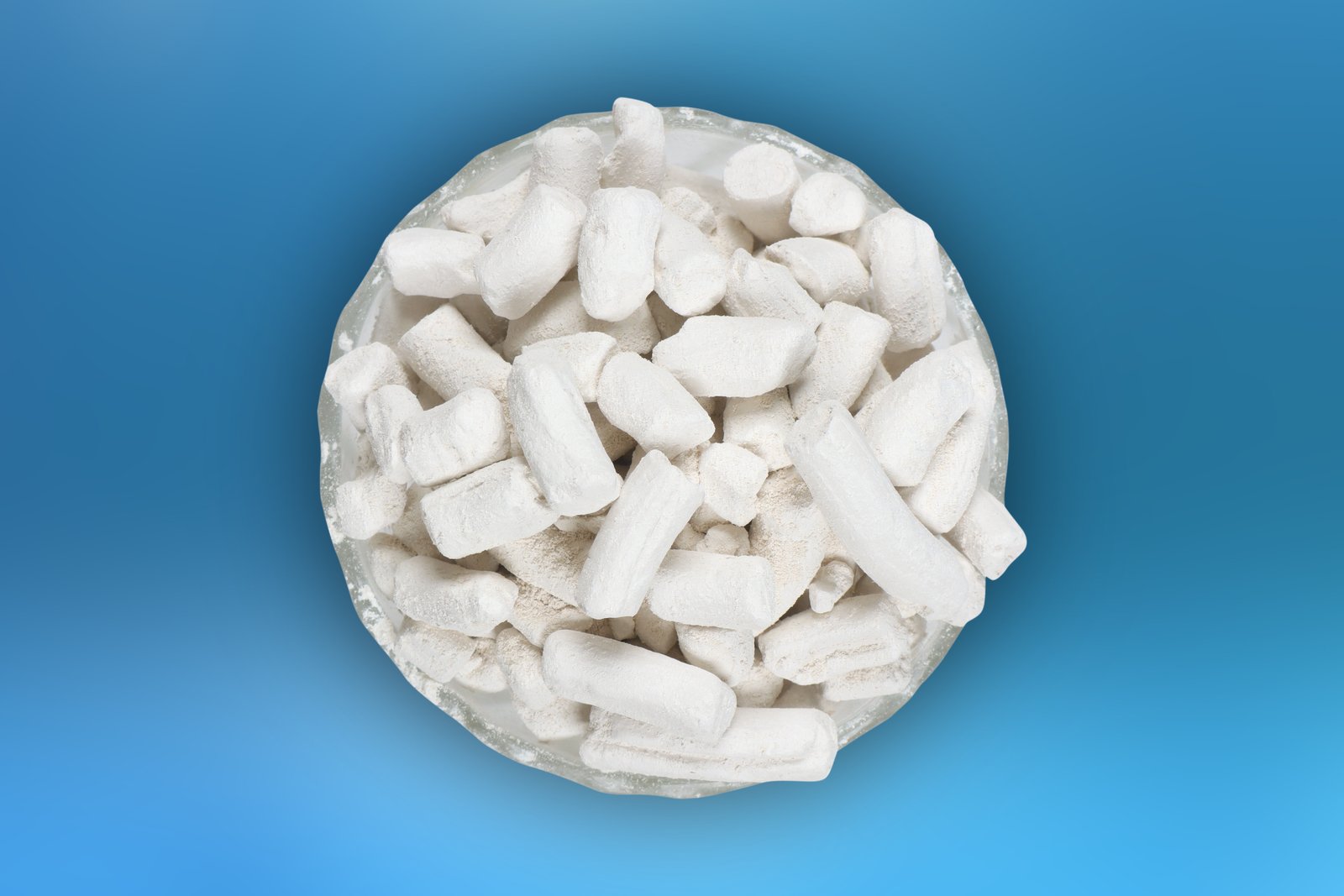
Extruded kaolin clay noodles for easy handling, reduced dust, and controlled feeding in industrial processing.
Off-white to white cylindrical noodles with good thermal stability for ceramics, refractories, tiles, construction, rubber, and foundry applications.
| Material | Kaolin Clay (China Clay) |
| Color | Off-white to white |
| Form | Extruded noodles |
| Style | Hydrous aluminosilicate clay |
| Shape | Cylindrical noodles |
| Application | Ceramics, refractories, tiles, construction, rubber, foundry |
3000 Metric Ton
Supports bulk orders with flexible packing options (25 Kg / 50 Kg / 1 MT) for domestic and export supply.
Share required quantity and destination for availability and dispatch schedule.
HDPE bags / PP bags / Jumbo bags
| K₂O | TiO₂ | SiO₂ | Al₂O₃ | Fe₂O₃ | CaO | Na₂O | Loss on Ignition |
|---|---|---|---|---|---|---|---|
| 0.5 – 2.5% | 45 – 55% | 35 – 40% | 0.3 – 1.2% | 0.1 – 0.5% | 0.1 – 0.6% | 12 – 14% |
| Specification | Details | Specification | Details |
|---|---|---|---|
| Melting Point | 1750°C – 1785°C | Thermal Conductivity | Low |
| Specific Gravity | 2.55 – 2.65 | Dimensional Stability | Excellent at high temperatures |
| Density | 2.4 – 2.6 g/cm³ | Porosity | Low to medium |
| Strength | Moderate (improves after firing) | Water Absorption | 10% – 18% |
| Hardness | 2 – 2.5 (Mohs scale) | Foam | Nil |
| Moisture | 8 – 15% |
| Water Absorption | 35 – 55% |
| Water of Plasticity | 30 – 38% |
| Oil Absorption | 30 – 45 g / 100 g |
| Content | Data |
|---|---|
| Grain Size (D50) | 1 – 5 µm |
| Particle Size Distribution | Fine, narrow |
| Residue on 325 Mesh | 0.5 – 3.0% |
| Wet Screen Residue | < 2% |
| Surface Area (BET) | 10 – 20 m²/g |
| Content | Data |
|---|---|
| Drying contraction | 2 – 4% |
| Firing contraction | 1 – 3% |
| Total contraction | 3 – 7% |
| Contraction (overall) | Low compared to ball clay |
| Thermal Conductivity | 0.2 – 0.4 W/m·K |
| Firing Temperature | 1100 – 1300 °C |
| Thermal cycles resistance | Good |
| Cycles (mins) | 30–90 min (typical firing soak) |
| Content | pH (aqueous slurry) | Fluorine (F) | MgO | Water-soluble salts |
|---|---|---|---|---|
| Typical | 4.5 – 6.5 | <0.01% | 0.05 – 0.5% | <0.1% |
| Component | Typical Range |
|---|---|
| Kaolinite | 85–98% |
| Mica / Illite | 0–5% |
| Quartz | 1–10% |
| Feldspar / Anatase (trace) | <1% |
Quality checks and documentation to support consistent supply
We follow standard checks to ensure consistent quality and compliance.
Quality, reliability, transparency, and customer support in every shipment.
Any test reports can be shared on request at an additional cost, including third-party testing where required.
Processed grades suitable as fillers for ceramics, paper, paints, and coatings.
Common questions about Kaolin Clay Noodles
Noodles are often preferred for easier handling and reduced dust during storage, movement, and feeding into processing systems.
Yes, we can discuss size and packing preferences based on your handling and processing needs.
Samples and test reports can be arranged on request for evaluation and compliance needs.
Common uses include ceramics and other industrial processes where bulk handling and controlled feeding is important.
Yes, we provide export-ready supply and can support documentation and logistics coordination.